

- info@hlhmold.com
- +86-27-59089998
- ext 8020
- Room 507,Floor 5 ,Building E,Donghe Center,Wuhan Economic and Technological Development Zone, Wuhan, China
CAPABILITIES

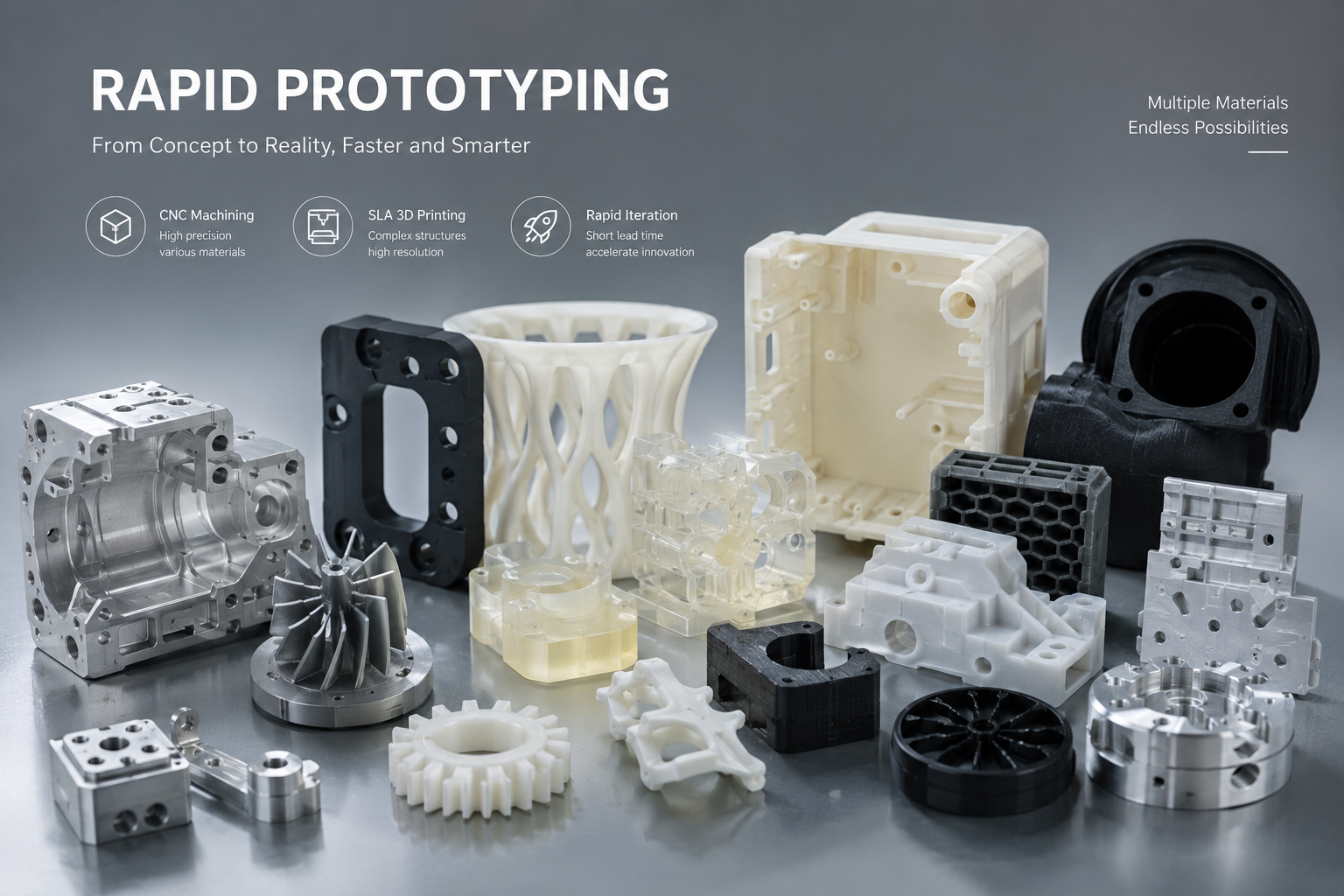
Moving a product from an initial concept to a production-ready part involves much more than creating a CAD model. Engineering teams must validate the design, test materials, verify tolerances, optimize manufacturing processes, and ultimately determine how the product should be produced at scale.
One of the most important manufacturing decisions is determining when CNC machining makes sense.
CNC machining can be used throughout the product development lifecycle, from early functional prototypes to low-volume production and, in some applications, ongoing production manufacturing. However, CNC machining is not always the most economical solution for every production volume or part geometry.
Understanding when to use CNC machining—and when to transition to another manufacturing process—can help companies reduce development risk, control production costs, and accelerate time to market.
At HLH Fastparts, we support companies throughout the transition from prototype to production. With a 12,000 sq/m manufacturing facility, more than 300 CNC processing machines, over 100 3D printing systems, and more than 30 years of industry experience, HLH Fastparts provides a broad range of manufacturing solutions for customers in more than 100 countries.
The transition from prototype to production is the process of moving a product from an experimental or development-stage part into a repeatable manufacturing process.
A typical product development process may include:
Different manufacturing technologies may be appropriate at different stages.
For example, a product team may initially use 3D printing to quickly evaluate the shape and assembly of a component. Once the design has been validated, the team may switch to CNC machining to test the part using a production-grade metal or engineering plastic.
Later, depending on production volume, the company may continue with CNC machining or transition to injection molding, die casting, or another manufacturing process.
This staged approach allows companies to invest in tooling and production infrastructure only when the design is sufficiently mature.
CNC machining is particularly useful when a prototype needs to behave like the final product.
A 3D printed model can be excellent for evaluating dimensions, appearance, and general assembly. However, a CNC machined prototype can provide a much closer representation of the mechanical characteristics of the final component when the same or similar production material is used.
CNC prototype machining is especially useful when engineers need to evaluate:
For functional prototypes, these characteristics can be more important than simply producing a physical model quickly.
One of the biggest advantages of CNC machining during product development is its ability to produce highly accurate functional parts.
During design validation, engineers may need to determine whether:
A CNC machined prototype can provide valuable information before a company commits to expensive production tooling.
This is particularly important for products containing multiple mechanical components, where a small dimensional error in one component can create problems throughout the assembly.
There is no universal rule that determines exactly when a company should move from 3D printing to CNC machining.
The decision depends on the purpose of the prototype.
HLH Fastparts offers both 3D printing and CNC machining capabilities, allowing customers to select the appropriate process as their product develops. The company's current manufacturing capabilities include SLA, SLS, DMLS, FDM, MJF, CNC milling, and CNC turning.
CNC machining is not limited to prototypes.
For companies that need tens, hundreds, or other relatively small quantities of parts, low-volume CNC machining can be a highly practical production solution.
This is especially useful when:
Because CNC machining does not require dedicated injection molds for every new component, companies can move directly from CAD data to finished parts.
This makes CNC machining particularly attractive for startups, engineering teams, industrial equipment manufacturers, and companies launching specialized products.
CNC machining can also serve as a bridge manufacturing process between prototyping and mass production.
Consider a company developing a new electronic device.
The engineering team may initially produce five or ten prototypes for design validation. After testing, the company may need 100 or 500 units for:
At this stage, investing in production tooling may still be premature.
CNC machining can provide the required parts while the company continues validating demand and finalizing the production process.
Once demand becomes predictable, the manufacturer can evaluate whether injection molding, die casting, or another mass-production technology offers a lower unit cost.
Injection molding is highly efficient for large production volumes, but it requires upfront tooling investment.
For a new product, the economics may not make sense if the company only needs a few hundred parts.
CNC machining can be more practical when:
Injection molding becomes increasingly attractive as production quantities increase and the design becomes stable.
The correct decision therefore depends on the relationship between part quantity, tooling investment, unit cost, and product lifecycle.
Another situation where CNC machining makes strong economic sense is customized manufacturing.
Traditional mass-production processes are optimized for repeatability. However, customized products may require frequent design changes or different configurations.
CNC machining can accommodate these changes simply by modifying the machining program and production data.
This flexibility makes CNC machining useful for:
For companies producing highly customized or low-volume products, avoiding dedicated tooling can be a major advantage.
Production volume is one of the most important factors when selecting a manufacturing process.
A simplified decision framework looks like this:
| Production Stage | Typical Requirement | Suitable Process |
|---|---|---|
| Early concept | Visual model | 3D Printing |
| Functional prototype | Accurate functional part | CNC Machining / 3D Printing |
| Engineering validation | Production-like performance | CNC Machining |
| Low-volume production | Tens to hundreds of parts | CNC Machining |
| Pilot production | Hundreds to thousands | CNC / Injection Molding |
| High-volume production | Large quantities | Injection Molding / Die Casting |
These are not fixed rules. Material, geometry, tolerances, tooling costs, and product lifecycle must also be considered.
A manufacturing partner with multiple technologies can therefore provide more flexibility than a supplier specializing in only one process.
The earlier manufacturing considerations are incorporated into product design, the easier it becomes to control cost.
Design for Manufacturing (DFM) is the process of evaluating a product design based on how efficiently and reliably it can be manufactured.
For CNC machining, DFM considerations may include:
A design that looks perfect in CAD may still be unnecessarily expensive or difficult to manufacture.
DFM feedback can identify these issues before production begins.
HLH Fastparts provides manufacturing capabilities designed to support different stages of product development.
The company operates a 12,000 sq/m manufacturing facility with more than 300 CNC processing machines and more than 100 3D printing machines. HLH also provides other manufacturing processes, including sheet metal fabrication, urethane casting, injection molding, and die casting.
This broad manufacturing capability allows customers to evaluate different production strategies instead of being locked into a single manufacturing process.
For example, a development project may progress through:
3D Printing → CNC Prototype → Low-Volume CNC Production → Injection Molding
This type of manufacturing pathway can reduce development risk while allowing the product team to make decisions based on actual test results and market demand.
A successful transition from prototype to production requires more than machine capacity.
Engineering communication, material selection, tolerance analysis, inspection, surface finishing, packaging, and logistics can all affect the final result.
HLH Fastparts provides a one-stop manufacturing approach, combining engineering support with multiple production technologies.
The company currently states that it serves customers in more than 100 countries and provides professional engineering support, comprehensive manufacturing capabilities, quality inspection, and worldwide shipment.
For customers moving from prototype development toward production, this integrated approach can reduce the need to coordinate multiple manufacturing suppliers.
Before selecting CNC machining for a new product, engineering and procurement teams should consider:
Quantity strongly influences the economics of CNC machining versus tooling-based manufacturing.
If yes, CNC machining may provide a more realistic functional prototype than some additive manufacturing processes.
Precision mechanical interfaces may favor CNC machining.
If major design changes are still expected, CNC machining can provide flexibility without committing to expensive production tooling.
Short-lived or specialized products may benefit from CNC machining even at relatively higher unit costs.
The best manufacturing strategy should consider the entire product lifecycle rather than focusing only on the first prototype.
CNC machining makes sense in many situations beyond traditional prototyping. It can support early functional validation, engineering testing, low-volume production, pilot production, customized products, and bridge manufacturing before mass production.
The key is not simply choosing CNC machining because it is fast or precise. Instead, companies should evaluate production volume, material requirements, tolerance, product lifecycle, tooling investment, and future manufacturing plans.
For companies developing mechanical, industrial, automotive, electronics, robotics, or other engineered products, CNC machining can provide a flexible path from prototype to production.
With more than 30 years of industry experience, over 300 CNC processing machines, a 12,000 sq/m manufacturing facility, and manufacturing capabilities covering multiple technologies, HLH Fastparts helps customers develop, validate, and manufacture parts from prototype through production.
CAPABILITIES