

- info@hlhmold.com
- +86-27-59089998
- ext 8020
- Room 507,Floor 5 ,Building E,Donghe Center,Wuhan Economic and Technological Development Zone, Wuhan, China
CAPABILITIES

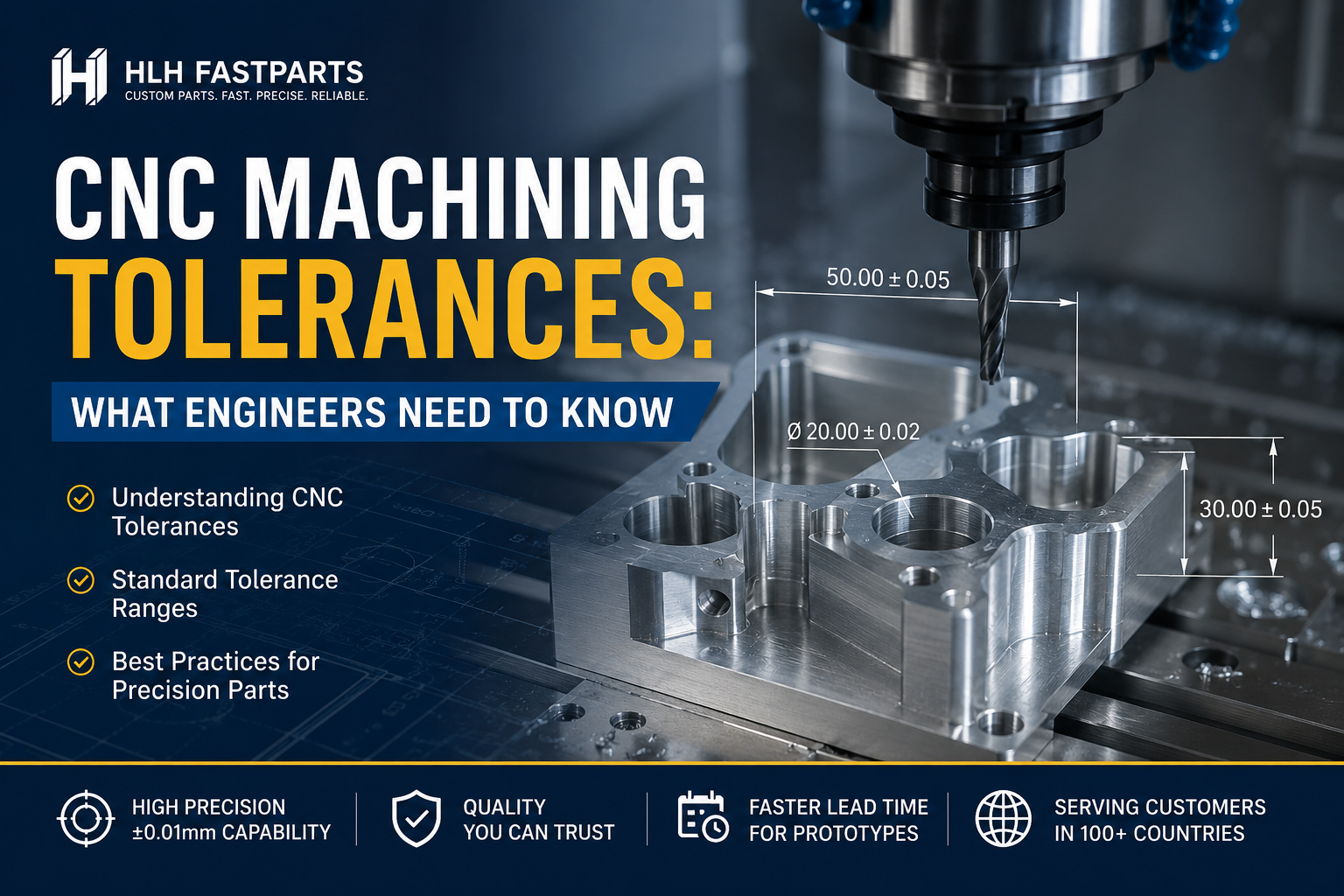
In precision manufacturing, tolerance control is one of the most important aspects of CNC machining. Engineers often focus on part geometry and material selection, but tolerances ultimately determine whether a component fits, functions, and performs as intended.
Specifying the right tolerance can significantly influence manufacturing cost, machining time, and overall product performance. Tight tolerances may improve accuracy, but they also increase machining complexity and cost.
At HLH Fastparts, we support customers worldwide with precision CNC machining services. With a 12,000 sq/m manufacturing facility, more than 300 CNC processing machines, and over 30 years of industry experience, we help engineers balance tolerance requirements with efficient manufacturing.
This guide explains how CNC machining tolerances work and how to specify them correctly during prototype and production development.
In CNC machining, tolerance refers to the allowable variation in a part’s dimension from its nominal (intended) measurement.
For example:
Nominal dimension: 50.00 mm
Tolerance: ±0.05 mm
This means the final part can measure anywhere between 49.95 mm and 50.05 mm and still meet the engineering requirement.
Tolerance specifications ensure that parts:
Without proper tolerance control, even well-designed parts may fail during assembly or product operation.
Most CNC machining services follow industry-standard tolerances for general machining operations.
Typical standard tolerances include:
| Feature Type | Standard Tolerance |
|---|---|
| Linear dimensions | ±0.05 mm |
| Hole diameters | ±0.02 – ±0.05 mm |
| Shaft diameters | ±0.01 – ±0.03 mm |
| Angular dimensions | ±0.5° |
These ranges allow manufacturers to produce high-quality parts efficiently while maintaining reasonable machining costs.
At HLH Fastparts, standard CNC tolerances typically fall within ±0.05 mm, with tighter tolerances available when required by the design.
Many engineers assume tighter tolerances always improve product quality. However, unnecessarily tight tolerances can dramatically increase manufacturing complexity.
Several factors contribute to higher CNC machining cost when tight tolerances are specified.
Achieving tighter tolerances requires slower cutting speeds, multiple finishing passes, and more precise tool paths.
These adjustments increase machine cycle time and reduce overall production efficiency.
High-precision tolerances often require specialized tooling and high-accuracy measurement equipment such as:
These additional resources raise production cost.
The tighter the tolerance, the smaller the margin for manufacturing error. Even minor tool wear or thermal expansion can cause parts to fall outside tolerance limits.
This increases the risk of rejected parts and rework.
To optimize manufacturing efficiency, engineers should apply tight tolerances only where they are functionally necessary.
Best practices include:
Most features do not require extreme precision. Using standard tolerances reduces machining complexity and cost.
Features involved in assembly, sealing, alignment, or motion control may require tighter tolerances.
Examples include:
Other non-critical dimensions can remain within standard tolerance ranges.
Over-specifying tolerances across an entire part is a common mistake in early-stage product development.
Instead, engineers should identify critical-to-function features and apply precision where it matters most.
Tolerance requirements often differ between prototypes and mass production.
During prototyping, slightly wider tolerances are often acceptable because the goal is functional testing rather than final product performance.
Relaxed tolerances help reduce lead time and prototype cost.
In production, tolerances may be tightened to ensure repeatability, long-term reliability, and consistent assembly performance.
HLH Fastparts supports both stages, helping customers transition smoothly from prototype development to full production.
Maintaining tight tolerances requires rigorous quality control procedures.
At HLH Fastparts, precision verification includes:
These processes ensure every part meets engineering specifications before shipment.
Engineering teams need a manufacturing partner that understands the balance between precision and efficiency.
HLH Fastparts provides:
Our experienced engineering team works closely with customers to ensure tolerances are achievable, cost-effective, and aligned with real product requirements.
CNC machining tolerances play a critical role in part accuracy, product performance, and manufacturing efficiency. By specifying tolerances strategically, engineers can reduce production costs while maintaining the precision needed for reliable product performance.
With extensive manufacturing capabilities and decades of experience, HLH Fastparts helps companies achieve the right balance between precision, cost, and production efficiency.
CAPABILITIES